Materials
rPP PIR Pellets — Recycled Polypropylene for Compounding Applications
rPP PIR Pellets — Recycled Polypropylene for Compounding Applications
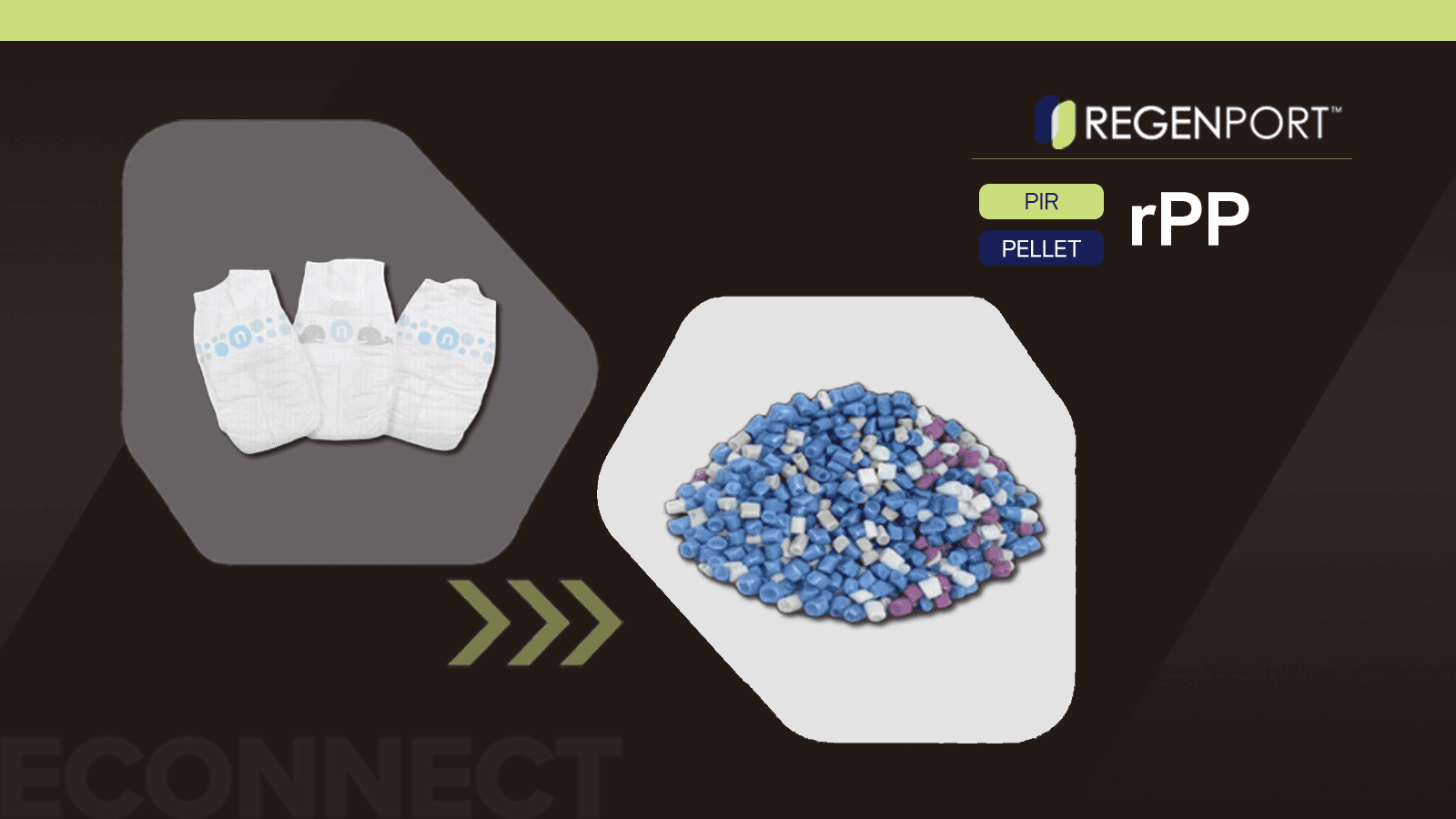
How post-industrial diaper waste is processed into rPP PIR pellets — and what GRS certification means for recycled content traceability.
Polypropylene is widely used in industrial manufacturing, but feedstock quality, processing consistency, and traceability vary significantly between suppliers.
Regenport's rPP PIR pellet is reclaimed from post-industrial diaper manufacturing waste — a controlled, traceable feedstock that produces a mixed-color pellet with consistent physical properties suited for compounding applications.
Material Data
rPP | |
|---|---|
CONDITION : | TYPE : PIR |
FEEDSTOCK : Diaper | APPLICATION : Compounding |
MFI (200°C, 5kg) : 48.6 g/10min | DENSITY : 0.9 g/cm³ |
From diaper to rPP PIR pellet: how the feedstock loop works
Post-industrial diaper waste is collected directly from manufacturing lines before consumer use, making it one of the more consistent PP waste streams for PIR processing. This feedstock minimizes contamination risk and supports batch-to-batch uniformity.
The result is a mixed-color PIR pellet suited for compounding processes where melt flow consistency and density stability are key requirements.
Where rPP PIR fits in your compounding line
With an MFI of 48.6 g/10min and a density of 0.9 g/cm³, rPP PIR is compatible with standard PP compounding workflows. For formulators building recycled content blends, material properties and test data are available in the technical datasheet.
GRS certification means recycled content claims are independently audited — a requirement across an increasing number of European and global supply chains. For procurement teams adding PIR content to their supply mix, rPP PIR is a practical starting point.
Request a sample or datasheet
rPP PIR pellets are available now — 40MT/month, GRS-certified, South Korea origin. Request a sample or technical datasheet and our team responds within 24 hours.
Polypropylene is widely used in industrial manufacturing, but feedstock quality, processing consistency, and traceability vary significantly between suppliers.
Regenport's rPP PIR pellet is reclaimed from post-industrial diaper manufacturing waste — a controlled, traceable feedstock that produces a mixed-color pellet with consistent physical properties suited for compounding applications.
Material Data
rPP | |
|---|---|
CONDITION : | TYPE : PIR |
FEEDSTOCK : Diaper | APPLICATION : Compounding |
MFI (200°C, 5kg) : 48.6 g/10min | DENSITY : 0.9 g/cm³ |
From diaper to rPP PIR pellet: how the feedstock loop works
Post-industrial diaper waste is collected directly from manufacturing lines before consumer use, making it one of the more consistent PP waste streams for PIR processing. This feedstock minimizes contamination risk and supports batch-to-batch uniformity.
The result is a mixed-color PIR pellet suited for compounding processes where melt flow consistency and density stability are key requirements.
Where rPP PIR fits in your compounding line
With an MFI of 48.6 g/10min and a density of 0.9 g/cm³, rPP PIR is compatible with standard PP compounding workflows. For formulators building recycled content blends, material properties and test data are available in the technical datasheet.
GRS certification means recycled content claims are independently audited — a requirement across an increasing number of European and global supply chains. For procurement teams adding PIR content to their supply mix, rPP PIR is a practical starting point.
Request a sample or datasheet
rPP PIR pellets are available now — 40MT/month, GRS-certified, South Korea origin. Request a sample or technical datasheet and our team responds within 24 hours.
Interested in samples or volume pricing?
Interested in samples or volume pricing?
sales@e-connect.kr
sales@e-connect.kr
ECONNECT Featured in Dong-A Ilbo: How We're Using AI to Make Plastic Recycling Economically Viable
ECONNECT Featured in Dong-A Ilbo: How We're Using AI to Make Plastic Recycling Economically Viable
DfR Packaging Regulation: Why Design for Recycling Is Now a Legal Requirement
DfR Packaging Regulation: Why Design for Recycling Is Now a Legal Requirement
rPP PIR Pellets — Recycled Polypropylene for Compounding Applications
rPP PIR Pellets — Recycled Polypropylene for Compounding Applications
rHDPE PCR Pellets — Recycled HDPE for Industrial Manufacturing
rHDPE PCR Pellets — Recycled HDPE for Industrial Manufacturing
r-EPS Recycled Polystyrene Pellets: PCR Resin for Styrofoam & Packaging Manufacturers
r-EPS Recycled Polystyrene Pellets: PCR Resin for Styrofoam & Packaging Manufacturers

CONTACT US
Fill out the form and we'll get back to you
within 1 business day.